
Data Curation · Framework
Metabolic Drift Framework
Not a risk calculator and not a diagnostic test — a targeted metabolic drift monitoring system anchored to genetically-defined functional constraints.
Targeted
Not everything is measured — only what has leverage. Candidate genes define the targets; every marker answers a specific question about a specific bottleneck.
Metabolic drift
Not a tumour on a scan or a static risk percentile, but the slow shift of function over time: the 2/16 ratio moving away from optimal, a shortening luteal phase, rising inflammatory markers, declining HRV.
Genetically anchored
Drift is not random. Common variants that function at reduced efficiency make certain kinds of drift more likely — and more consequential — for one particular body.
Why this matters to me
Managing my own n=1 family-history risks, starting with estrogen-dominant breast cancer.
This framework is not theoretical. I am using it to move beyond an annual mammogram and wait-and-see protocol. My aim is to detect adverse metabolic drift earlier — the subtle shifts in estrogen metabolism, inflammation, mitochondrial output, and immune recovery that can create a more cancer-supportive environment long before any scan would show a problem.
The investigative idea is that by monitoring in line with my own inherited functional constraints, and my functional biomarker data, I can intervene sooner and more precisely: adjust inputs, refine posture, and track whether the drift is bending back in a healthier direction. What you see here is the living documentation of that personal experiment.
Posture, not prevention
A course correction, not a verdict
Prevention implies certainty; risk assessment implies a static label. Posturing is dynamic — positioning the body, through diet, supplements, movement, environment and monitoring, so that drift is corrected early, before it reaches the threshold where disease becomes possible. It is a way of relating to your own biology over time rather than a one-time fix.
The hallmarks of aging are genetics-agnostic: everyone experiences genomic instability, senescence, mitochondrial decline. That universality is their power and their limit. They are the map of the continent; your genes describe the specific terrain you live on — where the river floods, how slow the cleanup crew is, how intense the inflammatory weather runs. This framework is not in tension with the hallmarks. It is their clinical translation for one person.
Working example · n=1
Multi-omic prevention framework for ER+ breast cancer
The five data layers, with clinical screening as the confirming sixth, applied to a personal estrogen-metabolism landscape.
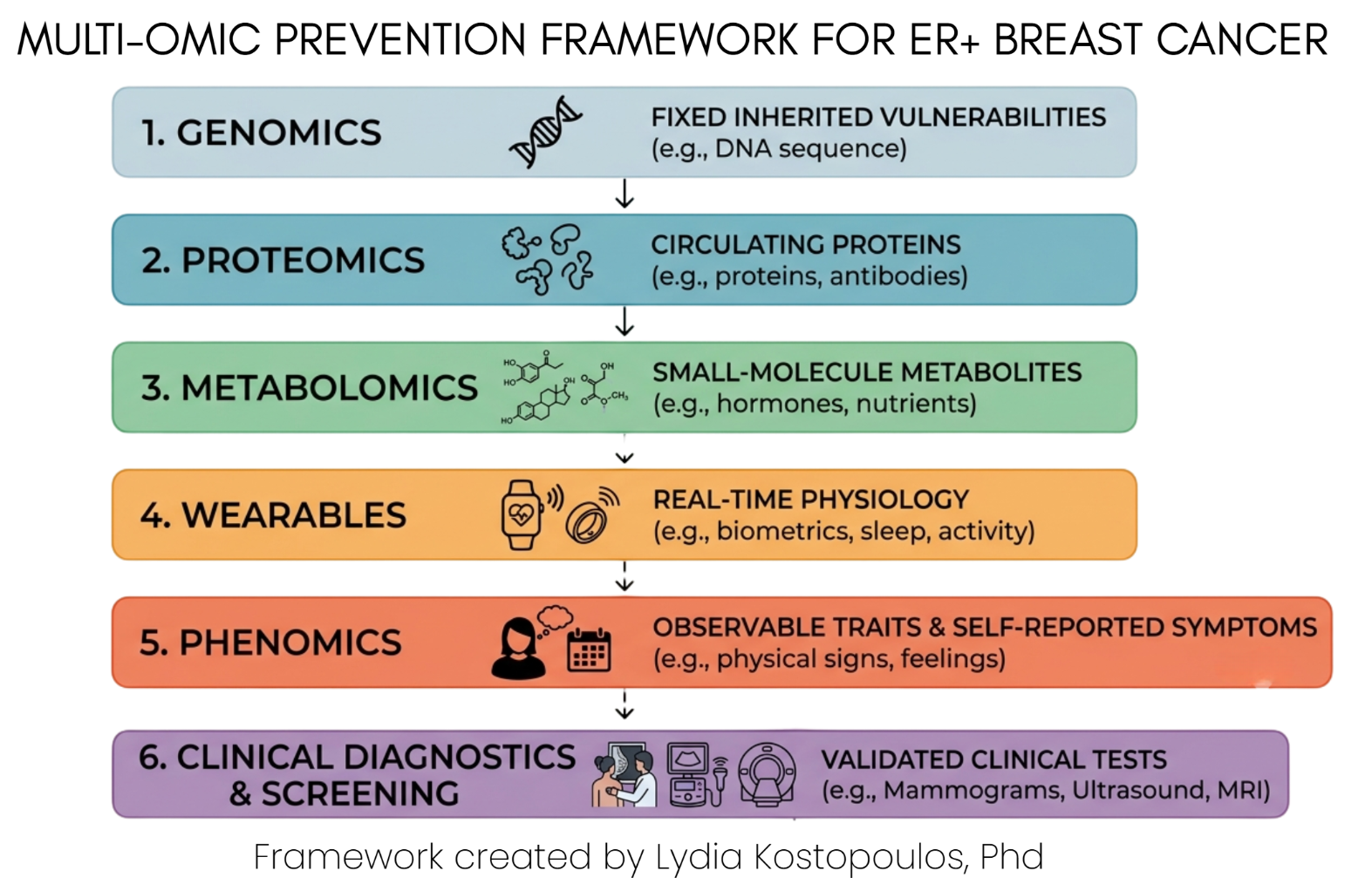
The layers
Genomics
Fixed inherited vulnerabilities. Common variants that function at reduced efficiency define where the bottlenecks sit — and therefore what is worth measuring at all.
Proteomics
Circulating proteins and antibodies read as the functional expression of those constrained pathways.
Metabolomics
Small-molecule metabolites — hormones, catechol estrogen ratios, nutrients — chosen because they sit directly downstream of the candidate genes.
Wearables
Real-time physiology: HRV, sleep architecture, cycle length, activity load. The daily output of the same pathways, sampled continuously.
Phenomics
Observable traits and self-reported symptoms. What the body registers before any instrument does.
Clinical diagnostics & screening
Validated tests — mammogram, ultrasound, MRI — as confirmation layer, not as first signal.
Hallmarks, personalised
Where the drift is fastest, and what answers it
Genomic instability
CYP1B1 CG + COMT Met/Met — 4-OH catechol estrogens can form DNA-adducting quinones when methylation is insufficient.
Sulforaphane, 5-MTHF with magnesium, DIM.
Cellular senescence
SIRT1 rs7895833 AA — lower baseline SIRT1, a key regulator of senescence and mitochondrial health.
Exercise, time-restricted eating, polyphenol-rich foods, NAD+ precursor support.
Altered intercellular communication
IL6 CG — higher inflammatory signalling.
Omega-3s, astaxanthin, Zone 2 exercise, anti-inflammatory diet.
Mitochondrial dysfunction
SIRT1 AA, plus a history of infrasound-induced mitochondrial stress and VO₂ max collapse.
CoQ10, astaxanthin, Zone 2 cardio, creatine.
Stem cell exhaustion
FSHR AA — ovarian aging trajectory may differ; slow immune cell recovery.
White blood cell monitoring, zinc, vitamin D, sleep, stress management.
None of these are anti-aging in the generic sense. They are targeted responses to the specific way the hallmarks are most likely to manifest in one body — genetics-informed, hallmarks-guided, and monitored as a trajectory rather than a verdict.