
Neuroarchitecture · Featured Framework
Genetic Sensory Architecture Software
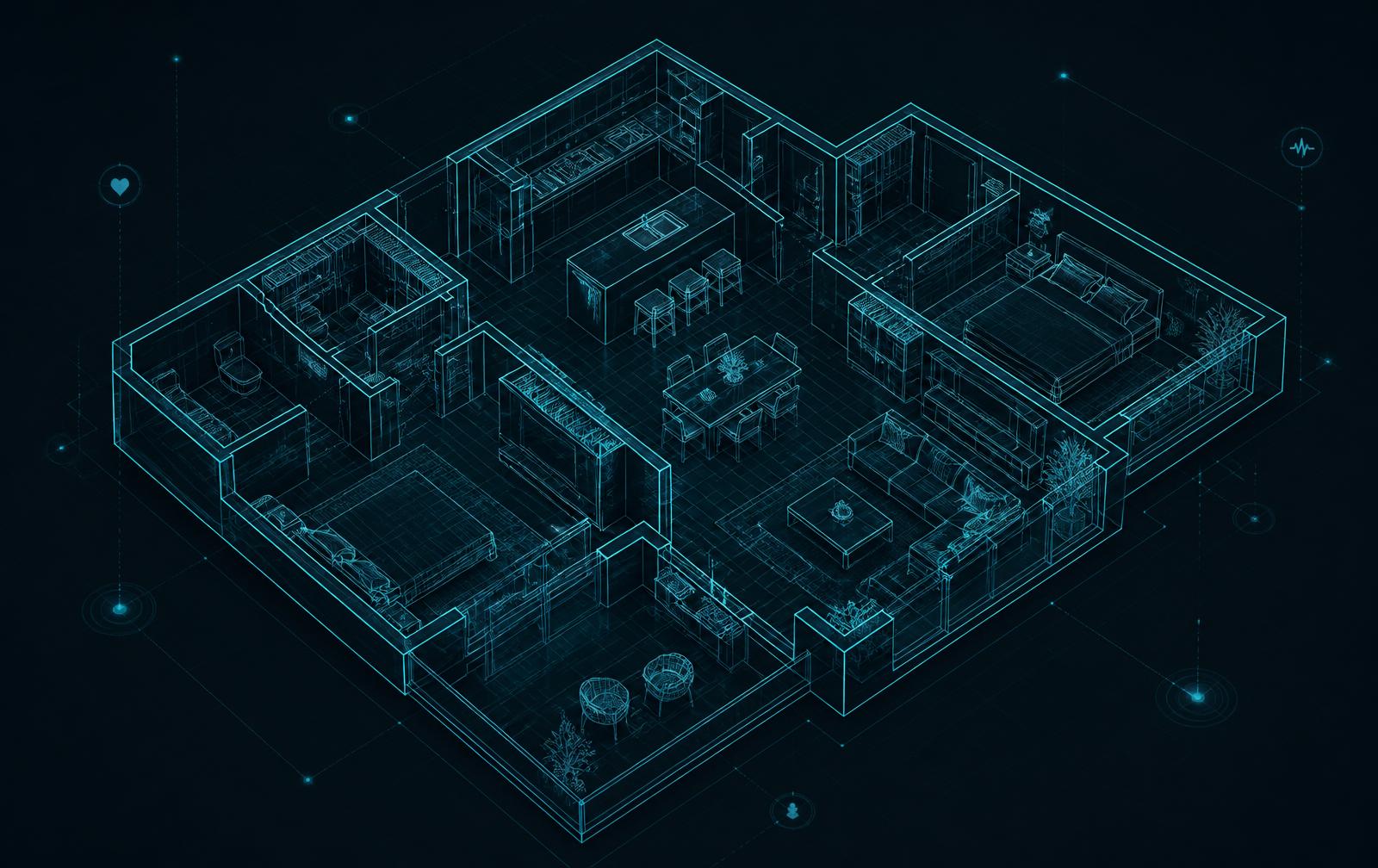
Two people can occupy the same room and inhabit entirely different environments. This software takes sensory-processing variation seriously and returns buildable parameters for the spaces a person lives and works in.
Inputs
Sensory profile, chronotype, genotype markers, and measured room data.
Parameters
Spectral light curves, reverberation targets, thermal bands, tactile palette.
Handoff
Specification sheets an architect or contractor can build directly from.
Origins
The Foundation of Sensory Architecture
The framework began with a building, not a theory. After structural changes were made to the building I lived in, my health deteriorated — sleep, heart rate variability, and cognitive stamina all moved in the wrong direction. My neighbour, in the adjacent apartment, in the same structure, exposed to the same changes, felt nothing at all.
The difference was not the building. It was the body reading it. Bodies are configured differently at the level of how they detect and encode the physical world. That realisation became the software: an analysis of sensory-related genes that explains why an environment is neutral for one person and corrosive for another — and what to change about the space as a result.
Configuration, explained
What caffeine metabolism teaches us about fixed configuration
The CYP1A2 gene determines how quickly caffeine is cleared. An AA genotype clears it fast; AC is intermediate; CC is slow, so the same espresso lingers far longer and hits sleep and blood pressure differently. Nothing about that setting can be negotiated — it is the configuration you were issued.
What can be negotiated is everything around it: steeping time, bean and blend choice, dose, the hour of the last cup. The genotype sets the terrain; behaviour and environment decide how you travel it. Sensory architecture applies exactly this logic to buildings — the configuration is fixed, the space is the variable we get to design.
The core categories
Two foundational sensory systems the software analyses
Neural processing
How the nervous system encodes environmental stimuli — light, sound, rhythm, timing. The CRY2 gene, for example, helps regulate circadian rhythm, sleep-wake cycles, metabolism, and hormone production, which makes the spectral and temporal profile of a room's lighting a physiological input rather than a decorative one.
Mechanosensory
How cells detect mechanical force, vibration, temperature, and pressure. PIEZO1 and the TRPV channels translate physical forces — structural vibration, barometric shifts, thermal gradients — into chemical and electrical signals the body must then process, whether or not it is consciously noticed.
From configuration to design
Epigenetics is where the built environment gets its leverage
DNA is fixed; epigenetics is not. Gene expression responds dynamically to environmental inputs — light exposure and its timing, the acoustics and geometry of physical space, chronic stress, air quality, and nutrition. A space is therefore not a backdrop to health; it is a continuous input into it.
Curating intentional spaces reduces allostatic load — the cumulative cost of adaptation. And because it is a claim about one body, it can be tested as n=1: tracking HRV, sleep quality, recovery, task performance, cortisol, inflammatory markers, and qualitative self-reports before and after a spatial change, to see whether the environment is actually paying the body back.